
TomTom Traffic Index 2025: Canadian cities lost up to 112 hours annually in traffic as congestion persists
SMATS Traffic Solutions and TomTom today released Canadian findings from the TomTom Traffic Index 2025, revealing how congestion levels and time lost in traffic shifted across major Canadian cities over the past year. The TomTom Traffic Index 2025 highlights ongoing congestion challenges across Canadian cities within a North American context.

OTTAWA — Jan. 23, 2026 — SMATS Traffic Solutions and TomTom today released Canadian findings from the TomTom Traffic Index 2025, revealing how congestion levels and time lost in traffic shifted across major Canadian cities over the past year.
Based on anonymized and aggregated data from hundreds of millions of connected vehicles worldwide, the Traffic Index provides a consistent, city-level view of congestion, travel time, and delay.
The 2025 results show that congestion remains a persistent challenge across Canadian cities. At a national level, Canada ranked as the second most congested country in North America, trailing only Mexico and ranking ahead of the United States. Three Canadian cities are placed within the top 10 most congested cities in North America, underscoring that congestion pressures are concentrated in several major urban centres. While some cities have seen modest improvements, the data shows significant remains to be done to address congestion at a network-wide level.
Canada is more congested than the U.S.
In 2025, Canada ranked as the second most congested country in North America, with an average congestion level of 22%, trailing only Mexico at 37%. Canada ranked ahead of the United States, which recorded an average congestion level of 19%.
Top 10 Canadian cities with the highest congestion levels
In 2025, Canadian cities ranked as follows based on congestion levels, defined as the average additional time lost to traffic, compared to driving in free-flow conditions:
- Vancouver ranked 1st in Canada in 2025, with drivers losing 112 hours per year after a 0.8% increase in congestion from 2024.
- Toronto ranked 2nd nationally, with 100 hours per year lost, maintaining its 2024 position despite a 1.8% improvement in congestion.
- Halifax ranked 3rd in Canada, with drivers losing 111 hours per year, holding its 2024 position following a 0.4% improvement.
- Montreal ranked 4th nationally, shifting up from 5th in 2024, with congestion rising 0.7% and 89 hours per year lost.
- Quebec City ranked 5th in Canada, shifting from 11th in 2024, alongside a 1.6% increase in congestion and 69 hours per year lost.
- Winnipeg ranked 6th nationally, shifting from 4th in 2024, with a 0.3% increase in congestion and 94 hours per year lost.
- Ottawa ranked 7th in Canada, shifting from 9th in 2024, with congestion up 2.4% and 71 hours per year lost.
- London ranked 8th nationally, shifting from 6th in 2024, despite a 5% reduction in congestion and 72 hours per year lost.
- Calgary ranked 9th in Canada, shifting from 8th in 2024, with congestion up 0.3% and 65 hours per year lost.
- Edmonton ranked 10th nationally, shifting from 7th in 2024, with congestion rising 1.4% and 60 hours per year lost.
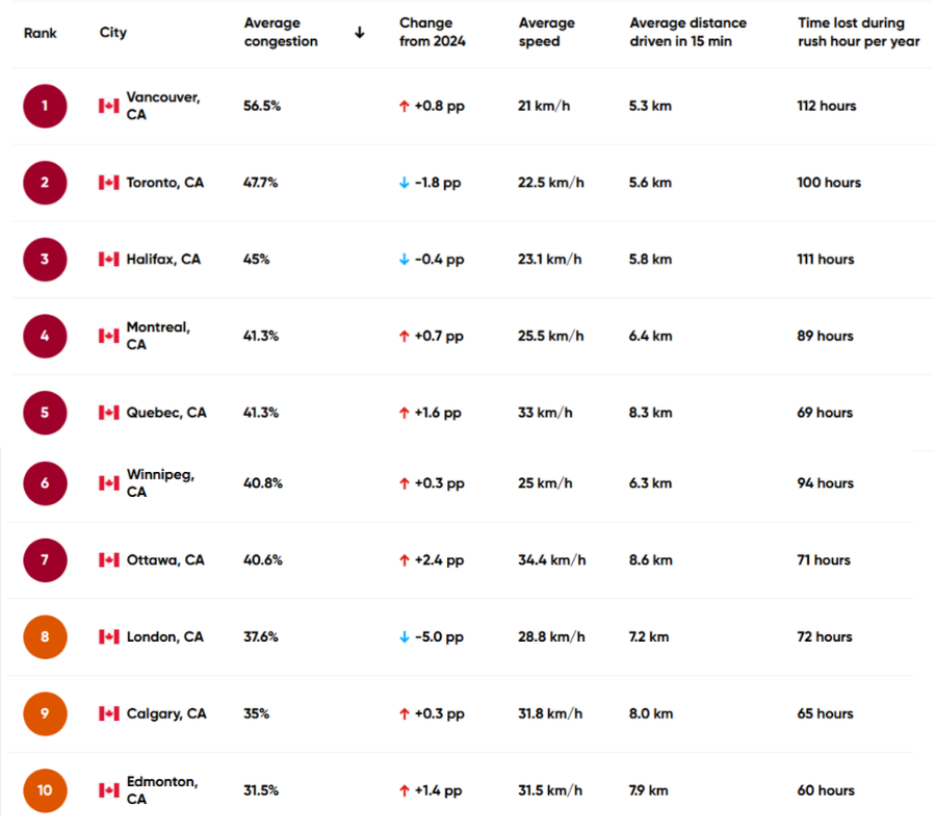
Overall, Canada’s national ranking remained structurally stable year over year, indicating that while congestion levels changed in some cities, relative congestion between Canadian cities shifted only modestly.
Most improved Canadian cities
London and Hamilton saw some of the largest improvements nationally, with congestion declining by approximately 5% and 4.1%, respectively.
Canadian cities in the North American ranking
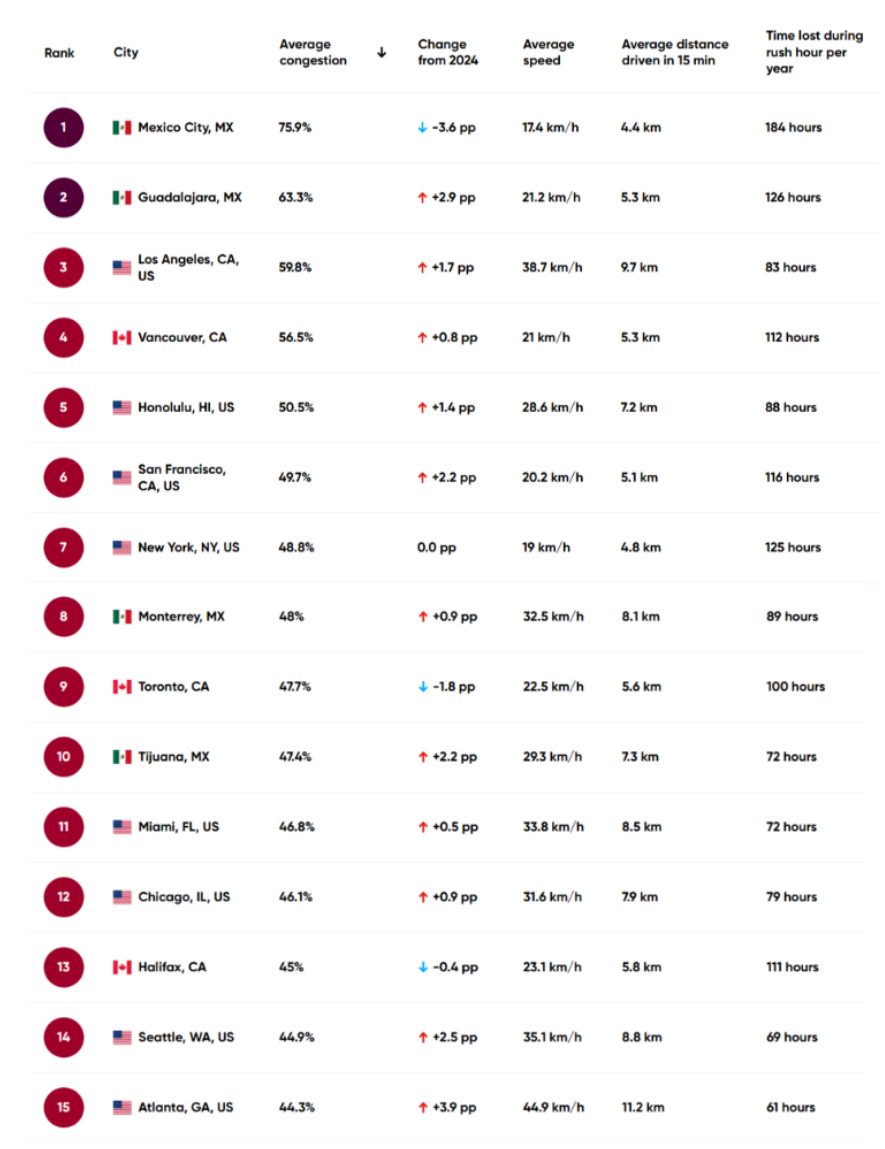
In the 2025 North American ranking, Canadian cities continued to feature prominently among the continent’s most congested urban areas, with several cities shifting position compared to 2024 as congestion dynamics evolved across the region:
- Vancouver ranked 4th most congested city in North America in 2025, shifting from 3rd in 2024. Vancouver remained the highest-ranked Canadian city in North America, positioned behind Mexico City, Guadalajara, and Los Angeles.
- Toronto placed 9th in North America, shifting from 7th in 2024, thanks to local congestion improvement and intensified congestion in several U.S. and Mexican cities.
- Halifax ranked 13th in North America, shifting from 12th in 2024, remaining among the top 15 most congested cities on the continent.
Data highlights opportunities for action
“The 2025 results show that while a handful of Canadian cities have made modest progress, most are effectively holding steady when it comes to congestion,” said Amir Ghods, CEO of SMATS. “The opportunity now is for public agencies to scale congestion monitoring across entire road networks, rather than addressing isolated locations. Congestion is dynamic and interconnected, and managing it effectively requires network-wide insights that support coordinated, system-level action.”
“As cities grow and adapt, we must address the multifaceted challenges that lead to increasing traffic congestion,” said Ralf-Peter Schäfer, Vice President for Traffic and Travel Information, TomTom. “The upward trend we see necessitates urgent action in smarter mobility planning, investments in public and shared transport, improved traffic management technologies, and coordinated policies. Our traffic data enables urban planners and policymakers to better understand these interconnected issues and make well-informed decisions that ensure cities remain livable, efficient, and sustainable in the face of growing congestion.”
About the TomTom Traffic Index
The TomTom Traffic Index is a global congestion benchmark covering hundreds of cities worldwide. Using anonymized GPS probe data from connected vehicles, it measures congestion levels, travel times, and peak-hour delay to support evidence-based transportation planning, operations, and policy decisions.
To access the full 2025 Traffic Index: www.tomtom.com/Traffic-Index
About SMATS Traffic Solutions
SMATS Traffic Solutions is a Canadian provider of advanced traffic data analytics, enabling transportation agencies to measure and manage road network performance using connected vehicle data across urban, suburban, and regional networks. To learn more about SMATS Traffic Solutions, visit: www.smatstraffic.com
-30-
For inquiries about the TomTom Traffic Index 2025 Canadian ranking, please contact:
Lucy Lai
Director, Product Marketing, SMATS Traffic Solutions
Phone: (613) 417-0309 x 105 | Email: lucy.lai@smats.ca
Reach out today
The first step towards a better traffic management solution!
Contact us